
.jpg?width=767&height=430&name=stw%C3%B3rz%20grafik%C4%99%20przedstawiaj%C4%85c%C4%85%20normalne%20kobiece%20brzuchy.%20kolory%20bia%C5%82o-czarny-%20fioletowy%2c%20styl%20%20komiksowy%2c%20spok%C3%B3j%20i%20stonowanie%20(1).jpg)
.jpg?height=200&name=stw%C3%B3rz%20obraz%20przedstawiaj%C4%85cy%20dziewczyn%C4%99%20robi%C4%85c%C4%85%20skr%C4%99ty%20w%20jodze.%20u%C5%BCyj%20kolor%C3%B3w%20bia%C5%82o-czarny-fioletowy%2c%20styl%20komiksowy.%20(1).jpg)
Twists in yoga: a natural way to support spinal health and improve digestion Why are twists so...
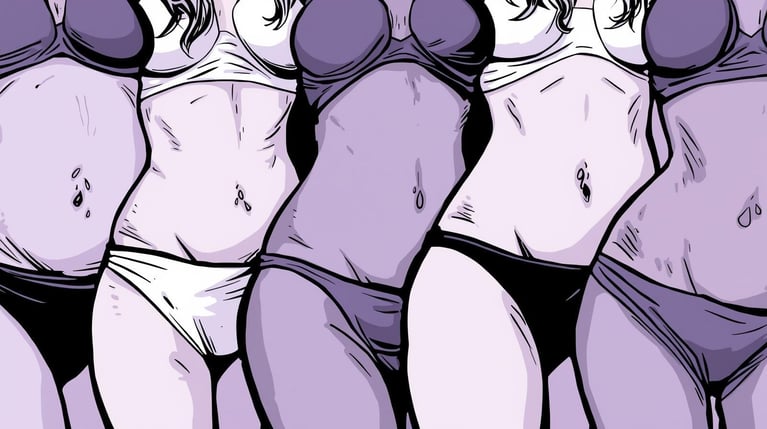
💚 The Female Belly — Why Did Nature Design It This Way?
Have you ever wondered why a flat stomach is so hard to achieve? Or whether “visible abs” are really a sign of health? Here’s what’s worth knowing about the female belly — without myths and pressure, but with a bit of biology and common sense.
Why Do Women Need Belly Fat?
Yes, fat also has a purpose! And it’s not just about “winter reserves.”
Women naturally have more body fat than men — and that is completely normal.
-
in men: 2–5% is essential fat,
-
in women: 10–13% is fat without which the body simply doesn’t function properly.
Why? Because this tissue:
-
helps produce estrogen (the hormone that regulates the menstrual cycle and supports fertility),
-
stores energy needed during pregnancy and breastfeeding,
-
protects internal organs,
-
and helps absorb vitamins A, D, E, and K (the fat-soluble ones).
Where Does Nature “Prefer” to Store Fat?
Most often around the:
-
hips,
-
thighs,
-
buttocks,
-
breasts,
-
and after menopause — also the belly.
This isn’t laziness — it’s biology and hormones. That’s simply how the female body works.
What Body Fat Levels Are Healthy?
| Category | Body Fat Percentage |
|---|---|
| Essential | 10–13% |
| Athletes | 14–20% |
| Physically fit | 21–24% |
| Healthy range | 21–33% |
| Above average | 32–35%+ |
Too low body fat (<14%) may cause:
-
loss of period,
-
hormonal disturbances,
-
weakened bones and immunity,
-
fertility problems.
Too high (>35%) increases the risk of:
-
insulin resistance,
-
type 2 diabetes,
-
heart disease and inflammation.
Are Visible Abs a Sign of Health?
Not always.
For abdominal muscles to be visible, body fat must drop to around 14–17%, which for most women means:
-
menstrual irregularities,
-
chronic fatigue,
-
low libido,
-
hormonal issues.
This is what professional athletes look like — but it’s the result of a very restrictive lifestyle that isn’t healthy long-term.
📊 Fun fact: At the 1983 Olympics, female athletes had an average of 14–22% body fat, and men 6–13%. But this is sports elite — not a reference point for everyday life.
The Belly Is Not Just Fat — It’s Also Space for Organs
A lot happens inside the abdomen. You’ll find: the stomach, intestines, liver, pancreas, spleen, kidneys, bladder, and in women additionally the uterus, ovaries, and fallopian tubes.
All of this needs space and protection. Fat tissue acts as a natural “safety cushion” — protecting, absorbing shock, and insulating.
Note: too much visceral fat (the fat around organs) is dangerous. Above about 100 cm² it may increase metabolic risks.
Breathe Through Your Belly — Literally!
Diaphragmatic breathing isn’t a yogic invention — it’s a natural way of breathing that:
-
improves lung function,
-
massages the internal organs,
-
calms the nervous system,
-
lowers blood pressure,
-
improves digestion.
When the diaphragm lowers, it presses on the organs — like a gentle massage from the inside.
That’s why the belly must be soft and elastic — too tight (e.g., from constantly sucking it in or obsessing over a “flat stomach”) disrupts breathing and organ function.
The Belly and Yoga — Why All Those Twists?
Twists in yoga are like a real SPA for the belly:
-
they stimulate the intestines,
-
improve blood flow,
-
release tension,
-
support digestion and detox,
-
and calm the nervous system.
They work a bit like “wringing out a sponge”: first compression (releasing toxins), then fresh blood and oxygen flowing in.
When should they be avoided?
-
during menstruation (may worsen cramps),
-
in pregnancy,
-
with spinal injuries, hernias, or reflux.
The Belly and the Cycle
Before menstruation, it is completely normal for the belly to feel more sensitive:
-
water retention,
-
bloating,
-
overall swelling.
During menstruation, uterine cramps and heaviness join in.
What helps?
-
gentle twists,
-
lying poses,
-
forward bends,
-
diaphragmatic breathing.
What’s better to avoid?
-
headstands,
-
intense sit-ups and planks,
-
deep backbends and strong twists.
To Sum Up:
✅ Belly fat is natural and necessary.
✅ Healthy range for women: 21–33%.
✅ Flat belly ≠ healthy belly.
✅ Elastic belly = better breath, digestion, and hormones.
✅ Yoga (especially twists and breathing) supports belly health.
✅ During menstruation — be gentle.
Conclusion:
A flat belly is not a marker of health.
A healthy belly has softness, space, and elasticity.
It’s the center of strength, emotion, and breath — treat it as a partner, not an enemy. 💚
Sources:
American Council on Exercise (ACE): Body Fat Percentage Guidelines
Heyward, V. H. (2013). Advanced Fitness Assessment and Exercise Prescription.
Institute of Medicine. Dietary Reference Intakes for Energy, Carbohydrate, Fiber, Fat…
Wells, J. C. K. (2007). Sexual dimorphism of body composition.
Simpson, E. et al. Aromatase and estrogens in human health and disease.
Nelson, L. R., Bulun, S. E. (2001). Estrogen production and action.
Matsuzawa, Y. et al. Pathophysiology and management of visceral fat.
Enoka, R. M. Neuromechanics of Human Movement.
Ma, X. et al. Diaphragmatic breathing and its physiological benefits.
McCall, T. (2007). Yoga as Medicine.
Field, T. (2011). Yoga clinical research review.
Hormonology / Women's Health Research Institute
Prior, J. C. Ovulation and menstruation physiology.
A Note
What I’m sharing here are my reflections and knowledge from various sources — not medical advice. Every body is different, so if you have health concerns, hormonal issues, or experience abdominal pain, it’s always best to consult a doctor or specialist. Listen to your body and treat this information as inspiration, not diagnosis. 💚
The articles I create are my way of deepening my understanding of yoga, bodywork, anatomy, and the mechanisms behind how and why our body reacts the way it does. I am not medically trained — these texts are my personal knowledge base and a space for conscious growth.

